Module eleven, which is personally one of my favorite additional readings, covers the topic of plant to environment interactions and greenhouse crop production. A few aspects to consider when thinking about annual growth is the photoperiod, lighting intensity and duration, humidity and temperature, and propagation at the juvenile stage.
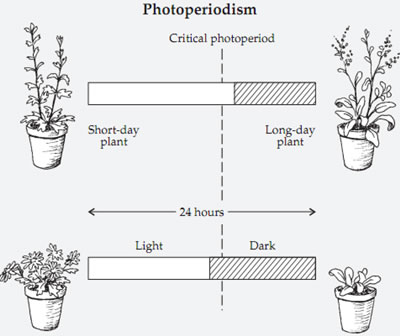
The photoperiod of a plant refers to the day length that stimulates appropriate growth. There are three primary types of photoperiods which are the SDPs, LDPs, and DNPs. SDP refers to short day plants, which are plants that need minimal light exposure and longer night lengths. LDP are the long day plants, opposite of the SDP, since they need longer day light exposure and shortened night lengths. DNP, or day-neutral plants, are plants that essentially grow regardless of varying day light or night length conditions. Different photoperiods are determined by a plant’s critical day length, or CDL, which is the amount of light that induces flowering in the plant. When trying to stimulate growth and flowering, everyday or every 24 hours is called the inductive cycle number. The CCN, or critical cycle number, refers to the shortest amount of inductive cycles possible that a plant must undergo to guarantee flowering.

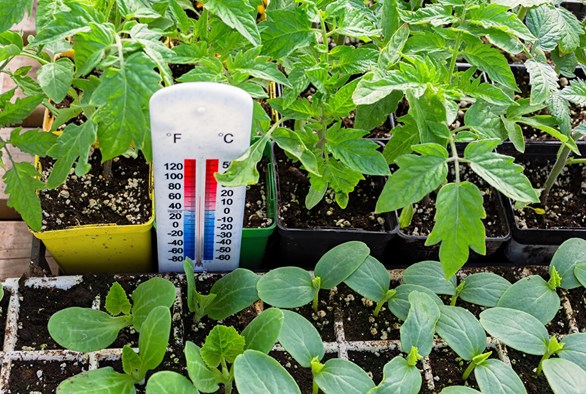
Temperature is important in dictating the photosynthetic process since it directly effects a plant’s development and growth. ADT, which is an acronym for average daily temperature, is typically contained around 45-85 degrees Fahrenheit since plants are very sensitive to extremes in temperatures. Heat delay is a problem with high increases in night temperatures causing flowers to wilt or delay in growth. A way to accommodate all flowering plants in order to optimize ideal growing and flowering conditions, the greenhouse manager should comprise a production schedule. This schedule should contain the target photoperiodic times for every species in the greenhouse, in addition to ideal sales dates. Scheduling the producing process of the greenhouse crops will also help the grower know when to change the flowering pot itself, so that the plants have enough room to grow correctly.
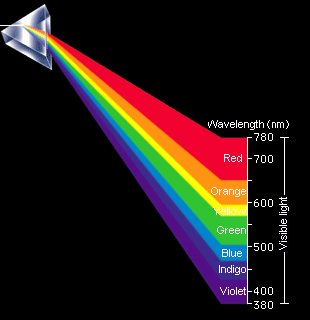
Electromagnetic radiation, the form of energy emitted from lighting structures, varies in how much energy can be used over an allotted amount of time, the wavelengths and color concentration or quality, and intensity (which is the amount of light per wavelength). PAR, also known as photosynthetically active radiation, is light emitted at 400-700 mm per wavelength. PAR is the light scale that people can visualize, increasing the PAR scale optimizes the photosynthetic and metabolic processes in a crop.
DLI, daily light integral, refers to the duration and intensity of light every 24 hours in reference to PAR. In other words, it in the total amount of PAR received daily. This is a vital concept since it helps to determine optimal plant growth, development, quantity and quality. If the DLI is low or delayed, plant growth is usually diminished. The ideal DLI is typically ten to twenty mols but should be checked for every species of plant as the DLI can vary. Additionally, supplemental lighting can help control DLI especially during the colder months.
 Site Title