Module four reviews different types of cooling systems as well as climate control in a greenhouse. There are pad and fan systems, misting systems, and fog systems. One type of cooling is known as “evaporative cooling” where water is evaporated, which causes a loss in energy thus a temperature drop, to the airstream.
There is a temperature measurement known as dry bulb, which is the temperature measured by a thermometer when exposed to regular conditions. Wet bulb temperature is another measurement, which focuses on the most minimal temperature attainable from the evaporated water vapor. Otherwise known as a measurement of air moisture. In order to measure relative humidity, or the moisture in the air, one can invest in either a sling psychrometer or an electronic humidity meter. The optimal time of measurement would be in the evening when solar radiation is at its peak, therefore the dry bulb and wet bulb temperatures are at their greatest difference.
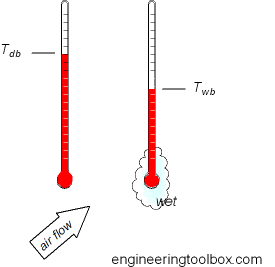
Wet bulb temperature is more consistent than the dry bulb temperature throughout the day. The largest potential for cooling is optimized when it is needed the most, which is when dry bulb temperatures are at their peak.
In order to achieve proper evaporative cooling, one may utilize a fan and pad cooling system or a high pressure fog system. Although the high pressure fog system is more cost intensive, it gives the most accurate readings. The fan and pad system consists of a water pump that circulates moisture through a pad at one end of the greenhouse and an exhaust fan installed at the other end of the greenhouse. Air moving through the pad will be at it’s coolest. As the air moves throughout the greenhouse towards the exhaust fan, it warms up and reaches its highest temperature once it arrives at the fan.
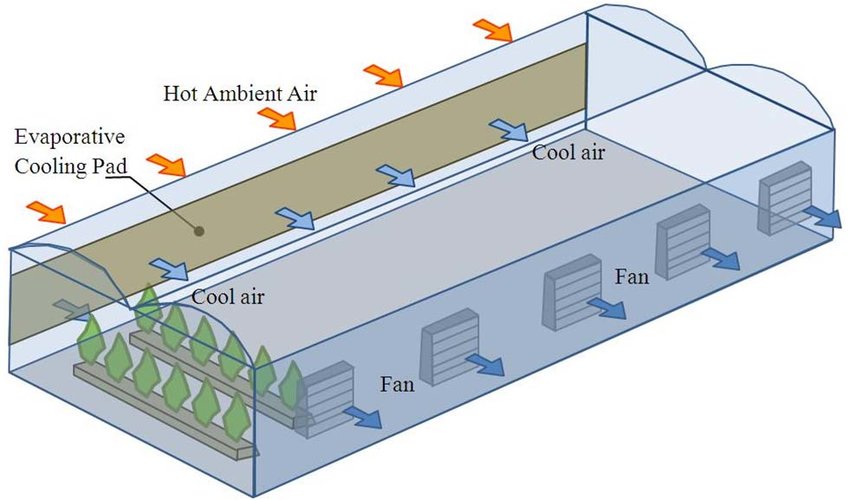
Measuring the temperature gradient may be difficult because there are so many variables , such as radiation exposure, physical obstacles and spacing, unique to each greenhouse. So the ideal value of wet bulb depression, which is the difference between wet and dry bulb temperatures, would be in the 85% efficiency range. The tighter the structure of the greenhouse, the more air will be propelled through the pads, and the more efficient the cooling system will be.
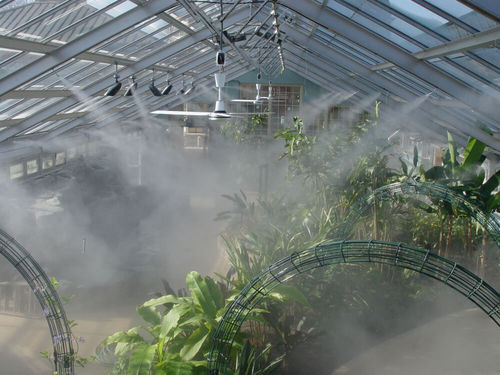
Misting is a system that is used for humidifying and approximate cooling. This system is set up from a water source or pump that distributes water through pipes, the pipes are then attached to nozzles that filter the liquid through. The misting units are typically placed amongst the produce, or overhead, in order to increase moisture and humidity.
An important role in understanding how to make one’s greenhouse thrive, is understanding the role of thermodynamics. This is the science that compares the relationship of heat and other forms of physical energy. There needs to be a harmony between outside seasonal temperatures, exposure of radiation, and indoor heating/cooling systems.
A major aspect to look for when determining air contents, is the measurement of water vapor available. This is because water vapor helps in photosynthesis and heavily determines the effects of heating. The temperature of the greenhouse affects the quantity of water vapor in the air, the higher the temperature the more air is capable of holding water vapor.
 Site Title